
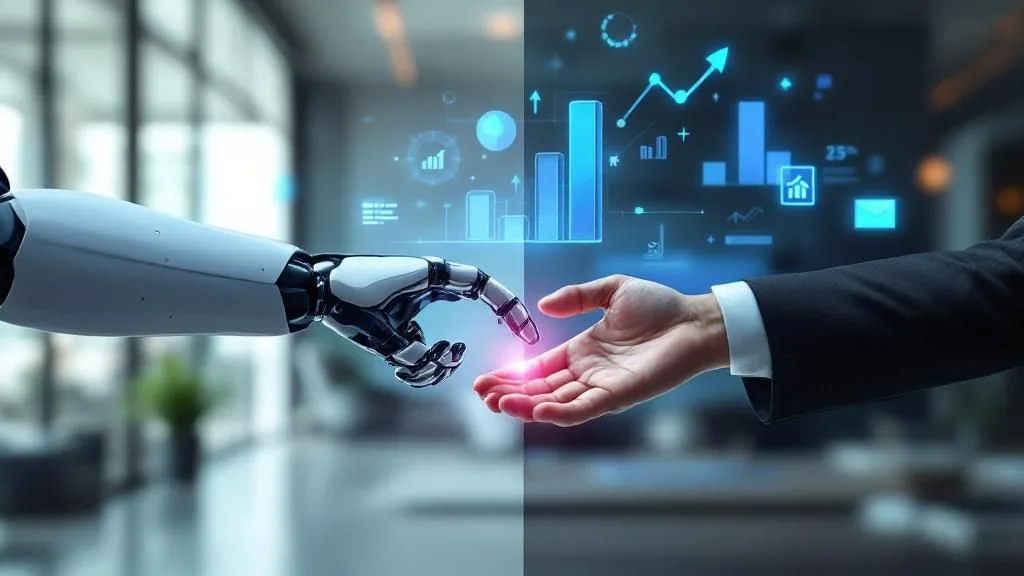
The narrative around ChatGPT replacing jobs misses the bigger picture. Based on my three decades in startups and observing thousands of companies navigate technological shifts, AI is transforming work rather than eliminating it. Smart business leaders recognize this distinction and position their teams accordingly.
What Does ChatGPT Replacing Jobs Actually Mean?
ChatGPT replacing jobs refers to AI systems automating specific tasks and workflows traditionally performed by humans, leading to role transformation rather than wholesale elimination. This process mirrors how spreadsheet software didn't eliminate accountants but fundamentally changed how accounting work gets done. The key insight: AI excels at routine, pattern-based tasks while humans remain essential for strategy, creativity, and complex problem-solving.
Which Jobs Face the Greatest Risk from AI Automation?
Data entry clerks, basic content writers, and customer service representatives handling routine inquiries face the highest displacement risk. However, even these roles are evolving rather than disappearing entirely.
I've watched companies transform their customer service operations by deploying AI for initial triage while human agents handle complex issues requiring empathy and creative problem-solving. The result: faster response times, higher customer satisfaction, and agents focusing on more engaging work.
| Job Category | Automation Risk | Transformation Pattern |
|---|---|---|
| Data Entry | High (80-90%) | Shifts to data validation and analysis |
| Basic Content Writing | Medium-High (60-70%) | Becomes content strategy and editing |
| Customer Service Level 1 | Medium (50-60%) | Focuses on complex issue resolution |
| Financial Analysis | Low-Medium (20-30%) | Emphasizes interpretation and strategy |
| Creative Design | Low (10-20%) | AI assists ideation and execution |
How Are Leading Companies Actually Implementing AI Without Mass Layoffs?
The most successful implementations I've observed follow a "augmentation-first" strategy. Companies deploy AI to handle routine tasks while retraining employees for higher-value activities.
Take my client's marketing team: instead of replacing content writers, they equipped them with AI tools for research and first drafts. Writing productivity increased 300%, but the team expanded because demand for high-quality content skyrocketed. The writers evolved into content strategists who understand both audience psychology and AI capabilities.
Gary Tan's "thin harness, fat skills" principle perfectly captures this dynamic. While companies rush to implement the latest tech stack, the future belongs to professionals who build deep, transferable competencies. Anyone can prompt GPT-4 to write blog posts, but the marketer who understands narrative psychology and buyer journey mapping creates content that converts at 10x higher rates.
What Skills Make Professionals Irreplaceable in an AI-Driven Workplace?
The highest-paid professionals in 2026 share common characteristics: they combine domain expertise with refined AI workflows they actually own and control.
Here's what I mean by ownership: spending weeks perfecting a content creation workflow with GPT-4, developing specific prompting sequences that generate high-converting ad copy. But when pricing changes or API restrictions force a platform switch, those months of fine-tuning become trapped. The conversation context, iterative improvements, and specific prompt engineering can't be exported.
Smart operators choose LLMs with robust export capabilities, maintain detailed prompt libraries outside platforms, and document refinement processes in transferable formats. They build reusable intellectual property that amplifies their skills rather than trapping them in black boxes.
- Strategic thinking: AI handles data processing, humans interpret implications
- Creative problem-solving: AI suggests solutions, humans evaluate feasibility and impact
- Emotional intelligence: AI lacks genuine empathy and cultural understanding
- Systems thinking: Understanding how changes ripple through complex organizations
- Cross-functional collaboration: Bridging departments and disciplines effectively
How Should Business Leaders Prepare Their Teams for AI Integration?
Start with skills assessment, not tool selection. I recommend mapping current roles against automation vulnerability, then identifying growth paths that leverage AI rather than compete with it.
The companies succeeding with AI integration focus on human-AI collaboration workflows. They train employees to become AI supervisors rather than AI competitors. For example, financial analysts learn to prompt LLMs for data gathering while focusing their expertise on strategic interpretation and recommendation development.
Investment in continuous learning programs pays dividends. Companies reporting 23% productivity gains from AI implementation typically spend 15-20% of their training budget on AI literacy programs. This isn't just technical training—it includes prompt engineering, output evaluation, and ethical AI usage.
What Does the Future Job Market Look Like with Widespread AI Adoption?
The job market is bifurcating into AI-augmented roles and AI-resistant positions. AI-augmented roles see productivity gains through human-AI collaboration. AI-resistant positions require uniquely human capabilities like creative leadership, complex negotiation, and emotional support.
New job categories are emerging faster than others disappear. AI trainers, prompt engineers, and human-AI workflow designers didn't exist five years ago but command premium salaries in 2026. The pattern mirrors previous technological transitions: short-term displacement, long-term job creation at higher skill levels.
From my experience advising foundations on AI-powered growth strategies, organizations successfully navigating this transition share common traits: they invest in employee development, embrace experimentation, and maintain focus on human creativity and strategic thinking.
Frequently Asked Questions
Will ChatGPT replace my job in the next two years?
Unlikely for most roles, but your job will likely transform significantly. Focus on developing skills that complement AI rather than compete with it. The professionals thriving in 2026 use AI as a powerful assistant while maintaining ownership of strategic thinking and creative problem-solving.
How can I make myself more valuable in an AI-dominated workplace?
Develop "fat skills"—deep competencies in areas like behavioral psychology, advanced data interpretation, and cross-functional collaboration. These transferable abilities work with any technological harness. Also, build portable AI workflows you own rather than depending on specific platforms.
Should companies implement AI gradually or rapidly?
Gradual implementation with employee involvement produces better outcomes than rapid deployment. Start with pilot programs in non-critical areas, gather feedback, and scale successful patterns. This approach maintains team morale while building organizational AI competency.
What industries are most resistant to AI job displacement?
Healthcare (patient care), education (personalized instruction), skilled trades (complex problem-solving), and creative services (original ideation) show strong resistance. These fields require human judgment, physical presence, or creative thinking that current AI cannot replicate.
How should I retrain my team for AI integration?
Focus on AI literacy first—understanding capabilities, limitations, and ethical considerations. Then provide hands-on training with specific tools relevant to your industry. Most importantly, frame AI as augmentation rather than replacement to reduce resistance and increase adoption.
What's the biggest mistake companies make with AI implementation?
Treating AI as a direct human replacement rather than a collaboration tool. The most successful implementations enhance human capabilities rather than substitute for them. Companies that focus solely on cost reduction through job elimination miss opportunities for productivity gains and innovation.
The conversation about ChatGPT replacing jobs requires nuanced understanding rather than blanket fears or enthusiasm. Smart business leaders recognize that AI transforms work rather than eliminates it entirely. If you're ready to develop an AI strategy that enhances rather than threatens your workforce, let's discuss how to position your organization for sustainable growth in this evolving landscape.
|||